In a nutshell
- 🧅 Cutting onions ruptures cells, letting alliinase act on ACSOs to form sulfenic acids, which lachrymatory factor synthase converts into the irritant syn‑propanethial‑S‑oxide (the lachrymatory factor) that triggers tears.
- 🍞 A bread slice’s porous crumb creates a small adsorption and dissolution “sink,” acting as a diffusion barrier that captures some fumes; slightly damp bread placed close to the cut face works best.
- ⚙️ For effectiveness: position bread beside or over exposed layers, keep it slightly moist and replace if saturated, leave the root end until last, use a sharp knife, and add gentle ventilation.
- 🧪 Evidence is mostly experiential: the trick reduces exposure but doesn’t neutralise onion chemistry; outcomes vary with onion variety, airflow, temperature, and cutting technique.
- 🥽 Strong alternatives include a fan/extractor, brief chilling of onions, and sealed goggles; combining methods delivers the most consistent tear reduction.
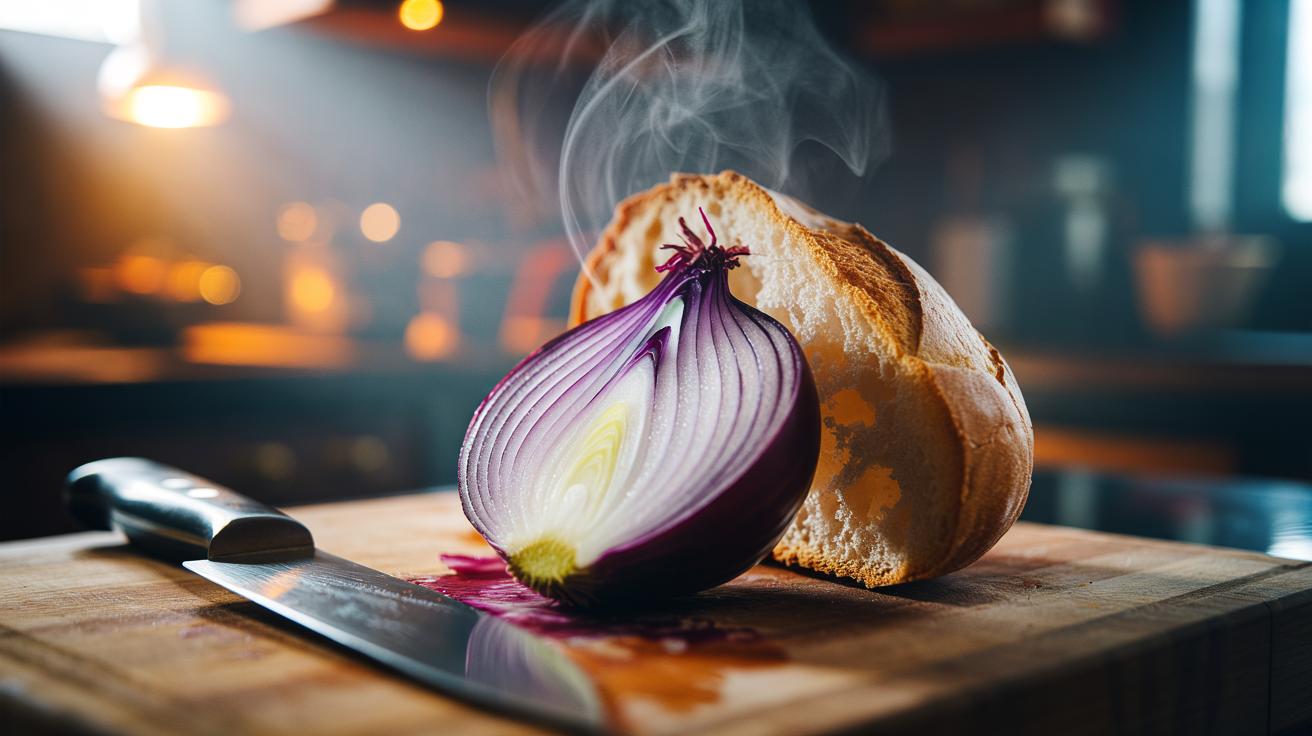
Every cook knows the sting: one swift slice into an onion and the kitchen turns into a tear-jerking theatre. Among the most shared home fixes is placing a slice of bread on or near cut onions to stop the weeping. The idea is simple and surprisingly plausible: a porous, slightly moist matrix might intercept irritating compounds before they reach your eyes. It will not “turn off” the onion’s chemistry, but it can cut the dose you breathe. Here’s how the science of onions intersects with the humble loaf, why the trick sometimes works, and how to make it work better without turning dinner prep into a lab experiment.
What Causes Onion Tears
Onions contain precursor molecules called ACSOs and the enzyme alliinase in separate cellular compartments. When you slice into the bulb, cells rupture and alliinase converts these precursors into sulfenic acids. A specialised enzyme, lachrymatory factor synthase, then rearranges 1‑propenyl sulfenic acid into the volatile irritant syn‑propanethial‑S‑oxide—often dubbed the onion’s lachrymatory factor. These molecules drift upward, meet the moisture of your eyes and nasal passages, and trigger nociceptors that prompt reflex tears.
In short, cutting releases a gas-like irritant, and your eyes water to flush it away. Warmer onions and rougher cuts accelerate release; a dull knife crushes cells, producing more gas. Airflow, humidity, and distance from the chopping surface all influence how much reaches your face. That’s why chefs preach three basics: a sharp knife, good ventilation, and efficient chopping to minimise exposure time.
Why a Slice of Bread Might Help
The crumb of bread is a lattice of bubbles and starch-protein walls with considerable surface area. Volatile compounds like syn‑propanethial‑S‑oxide can be captured by this sponge-like structure via adsorption (clinging to surfaces) and dissolution into thin films of moisture in the bread. Placed near the cut face, a slice creates a small “sink” that soaks up some fumes before they drift toward your eyes. Slightly damp bread often does better than very dry bread because dissolved irritants are less likely to re-evaporate quickly.
Think of it as a passive diffusion barrier. The effect is modest, not miraculous, because the gas continues to form as you chop. Still, when the slice is close—on the board, draped over the chopped pile, or even skewered like a little screen—it can trim the plume. It’s a low-cost, low-risk tactic that smooths the worst of the sting, especially in still kitchens.
How to Use Bread Effectively While Chopping
For best results, keep the bread where the gas is born. Place a half-slice directly beside or partly over the exposed onion layers, replacing it if it becomes saturated. Some cooks lightly moisten the crumb to enhance capture; avoid soaking, which makes a mess. Keep the onion’s root end intact until the final cuts—the root holds more precursors, so delaying it slows the cascade. Work quickly with a sharp knife to reduce crushing and total exposure time.
Pair the bread trick with basic controls. Angle your board under a gentle fan or hob extractor to push fumes away. Chill onions for 15–20 minutes to slow enzyme activity. Keep chopped onions to one side, topped with the bread “lid,” until you transfer them to the pan. When conditions are stubborn—tiny kitchens, no airflow—sealed goggles remain the most reliable fix. If you’re curious, test bread versus no bread on similar onions and note the difference.
Evidence, Alternatives, and Limitations
There’s limited peer-reviewed data specifically on bread and onion fumes, so most support is practical rather than clinical. The physics is sensible—porous media can intercept aerosols and vapours—and many households report marginal-to-noticeable relief. Still, results vary with onion variety, room airflow, and technique. The bread trick reduces exposure; it doesn’t neutralise the chemistry. For consistent protection, methods that move or block the plume tend to outperform passive absorption.
Below is a simple comparison of popular methods. Use the bread slice as an add-on rather than the sole fix, especially when chopping large quantities. Real, repeatable relief comes from moving fumes away or sealing off your eyes.
| Method | How It Works | Pros | Cons |
|---|---|---|---|
| Bread Slice | Porous crumb adsorbs/dissolves irritants near the source | Cheap, simple, food-safe | Modest effect; needs close placement |
| Fan/Extractor | Pushes plume away from face | Consistent; hands-free | Needs power/placement; can dry food |
| Chilling Onions | Slows enzyme activity and volatility | Easy; no gadgets | Minor flavour change if overchilled |
| Sharp Knife | Reduces cell damage and gas release | Better cuts; safer | Requires maintenance |
| Sealed Goggles | Blocks irritant from eyes | Highly effective | Bulky; looks odd |
So does a slice of bread “kill” the crying? Not quite—but it can blunt the sting by catching a share of the lachrymatory factor before it reaches your face. Treat it as a filter: keep it close, keep it slightly moist, and combine it with ventilation, a sharp knife, and swift technique. The result is less irritation and a calmer chopping session. What combination of simple tools—bread, fan, chill, knife—will you test in your kitchen to find your own sweet spot between convenience and tear-free results?
Did you like it?4.5/5 (26)